
Resolution To Aspect Ratio Converter
This is a free online converter that you can use to convert resolution (resolution pixels) to aspect ratio directly and easily.
Instantly find the exact aspect ratio of any screen, image, or video display by entering its width and height in pixels. Whether you are optimizing digital assets for front-end development, setting up video streaming configurations, or designing user interfaces, understanding how pixel dimensions scale is vital for maintaining visual integrity across diverse devices.
If you already know your desired proportions and need to calculate the corresponding width or height dimensions, you can easily reverse this calculation using our highly accurate aspect ratio to pixels converter.
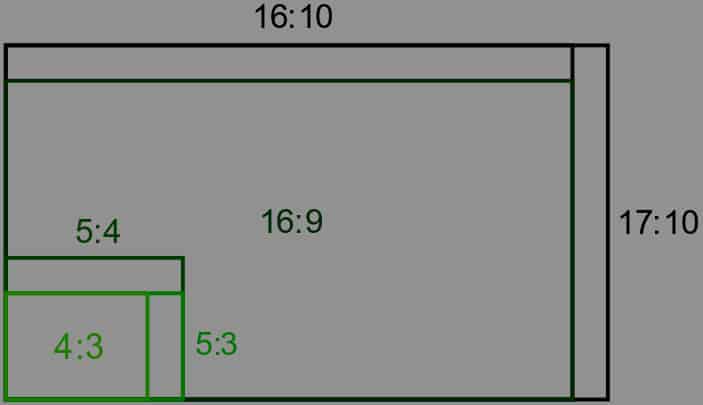
How to Convert Resolution to Aspect Ratio
An aspect ratio represents the proportional relationship between a display’s width and height, expressed as two numbers separated by a colon (X:Y). To calculate this programmatically or manually, you must find the Greatest Common Divisor (GCD) of both the horizontal and vertical pixel counts, and then divide both dimensions by that number.
The Mathematical Formula:
-
Identify the width (W) and height (H) in pixels.
-
Calculate the Greatest Common Divisor: GCD (W,H).
-
Divide both numbers to find the simplified ratio: Aspect Ratio = (W/GCD):(H/GCD)
For instance, when evaluating a standard Full HD monitor, analyzing the 1920 x 1080 aspect ratio reveals a GCD of 120. Dividing 1920 by 120 gives 16, and dividing 1080 by 120 gives 9, resulting in the iconic 16:9 widescreen standard.
Video tutorial: How to use the resolution to aspect ratio converter
Ultimate Resolution & Aspect Ratio Reference Guide
Different media types require specific display standards. Below is an exhaustive breakdown of how industry-standard resolutions simplify into explicit aspect ratios, from legacy displays to ultra-widescreen monitors and next-generation broadcasting setups.
| Common Resolution | Target Name / Standard | Simplified Aspect Ratio | Market Use Case |
| 1280 x 1024 | 1280×1024 resolution | 5:4 | Legacy desktop monitors, CCTV squares |
| 1440 x 1080 | HD Anamorphic | 4 3 resolution | Vintage television, retro gaming, film archives |
| 1600 x 900 | HD+ Display | 1600×900 aspect ratio | Budget laptops, entry-level external monitors |
| 1920 x 1080 | Full HD (FHD) | 16 9 resolution | Global streaming, Blu-ray, modern web video |
| 2560 x 1600 | WQXGA | 2560 x 1600 aspect ratio | Professional design laptops, productivity screens |
| 3440 x 1440 | Ultra-Wide QHD | 3440×1440 aspect ratio | Cinematic gaming, multi-window developer workstations |
| 3840 x 2160 | 4k resolution (UHD) | 4k resolution aspect ratio | Next-gen console gaming, premium streaming media |
| 7680 x 4320 | 8K Ultra HD | 8k aspect ratio | Future-proof broadcasting, ultra-high-fidelity displays |
Deep Dive into Core Display Formats
The Standard Widescreen (16:9)
The 16 9 resolution family is the undisputed standard for modern digital media. It spans across multiple tiers of hardware quality, stretching from basic laptops utilizing a sharp 1600×900 aspect ratio up to high-end multi-media monitors handling pristine 4k resolution feeds.
When dealing with high-fidelity production work, calculating the exact aspect ratio of 4k (specifically the 3840×2160 consumer standard) confirms that it maps perfectly to 16:9. This uniformity ensures that high-definition video content streams seamlessly without letterboxing or pillarboxing artifacts.
Productivity and Professional Formats (16:10 & 21:9)
Creative professionals and software engineers often require extra vertical space. Displays featuring a 2560 x 1600 aspect ratio leverage a 16:10 format, giving users more text-scrolling headroom when coding or editing timelines.
On the wider end of the spectrum, the ultra-wide 3440×1440 aspect ratio uses a 21:9 format. This setup provides an immersive field of view equivalent to running dual monitors side-by-side, without the intrusive center bezel.
Legacy and Industrial Formats (4:3 & 5:4)
Though less common in consumer electronics today, specific technical fields still rely heavily on square-format dimensions. A classic 4 3 resolution remains the standard baseline for retro game emulation layout matrices and legacy broadcast archival footage. Similarly, industrial workflows and server rack hardware interface terminals frequently run a native 1280×1024 resolution, mapping cleanly to a 5:4 display orientation.
Resolution to aspect ratio chart
This is a chart for all resolutions to aspect ratio conversion results commonly needed. you can get more results using the resolution to aspect ratio available above.
| Resolution | Aspect Ratio |
| 1024 X 768 | 4 : 3 |
| 1200 X 630 | 40 : 21 |
| 1280 X 720 | 16 : 9 |
| 1280 X 1024 | 5 : 4 |
| 1280 X 800 | 16 : 10 |
| 1280 X 960 | 4 : 3 |
| 1350 X 1080 | 5 : 4 |
| 1360 X 768 | 1.77 : 1 |
| 1366 X 768 | 1.78 : 1 |
| 1440 X 900 | 8 : 5 |
| 1680 X 1050 | 16 : 10 |
| 1900 X 1200 | 19 : 12 |
| 1920 X 1080 | 16 : 9 |
| 1920 X 1200 | 16 : 10 |
| 1920 X 960 | 2 : 1 |
| 2560 X 1440 | 16 : 9 |
| 2560 X 1080 | 64 : 27 |
| 2560 X 1600 | 16 : 10 |
| 3440 X 1440 | 2.39 : 1 |
| 3840 X 1600 | 12 : 5 |
| 3840 X 2160 | 16 : 9 |
| 3840 X 2400 | 16 : 10 |
| 5120 X 1440 | 32 : 9 |
| 5120 X 2160 | 64 : 27 |
Frequently Asked Questions (FAQ)
How does a 4:3 resolution differ from a 16:9 resolution in practical use?
A 4 3 resolution (such as 1024×768 or 1440×1080) produces a nearly square image, historically used for CRT televisions and retro gaming. Conversely, a 16 9 resolution is the modern widescreen standard for digital video and streaming. Displaying 16:9 content on a 4:3 screen naturally results in “letterboxing” (black bars on the top and bottom).
Why do many premium laptops use a 2560 x 1600 aspect ratio?
A display featuring a 2560 x 1600 aspect ratio simplifies to a 16:10 format. Many professional laptops utilize this standard rather than 16:9 because the added vertical height provides critical extra screen real estate for reading documents, writing code, and viewing complex timelines in video editing software.
Will a standard 4K resolution video stretch on an ultra-wide monitor?
By default, no. The standard consumer aspect ratio of 4k (3840×2160) is 16:9. If you play 4K media on a monitor with a 3440×1440 aspect ratio (which is 21:9), the media player will implement “pillarboxing”—adding black bars to the left and right sides of the screen. This preserves the original video proportions and prevents visual stretching.
Is a 1600×900 resolution considered high definition?
Yes, displays utilizing a 1600×900 aspect ratio are classified as High Definition Plus (HD+). While they do not offer the pristine pixel density of a Full HD or 4k resolution screen, they share the exact same 16:9 proportional footprint, ensuring modern content scales down natively without distortion.
What is the difference between 4K and 8K aspect ratios?
Structurally, there is no difference. Both the standard consumer 4k resolution aspect ratio (3840×2160) and the 8k aspect ratio (7680×4320) simplify perfectly to the 16:9 widescreen standard. The difference lies purely in visual data; an 8K display features exactly four times the total number of pixels as a 4K display.
Why does my older software require a 1280×1024 resolution?
Many legacy enterprise applications and industrial control systems were hardcoded for a 1280×1024 resolution, which scales to a 5:4 aspect ratio. Because these interfaces were designed strictly for nearly square monitors, attempting to run them on modern widescreen displays can sometimes cause graphical UI bugs or awkwardly stretched elements.