
Pixels To DPI Converter
Ever tried to print a gorgeous photo only to have it come out looking like a blurry, pixelated mess? Yeah, we’ve all been there. It usually comes down to one sneaky little acronym: DPI.
If you’re jumping between digital screens and physical prints, understanding the relationship between pixels and DPI is an absolute lifesaver. Luckily, you don’t need a math degree to figure it out. Our free Pixels to DPI Converter does the heavy lifting for you, ensuring your images look just as crisp on paper as they do on your screen.
Let’s dive into how it works, why it matters, and how you can get print-perfect results every single time.
What Exactly is DPI (and Why Should You Care)?
DPI stands for Dots Per Inch. Think of your printer like a tiny, incredibly fast painter that uses dots of ink instead of brushstrokes. DPI tells that painter exactly how many dots of ink to squeeze into a single inch of paper.
Here’s a real-world analogy: Imagine you’re packing a suitcase. If you throw in 10 loosely folded shirts, you’ve used up the space, but it’s not very dense. But if you tightly roll 300 shirts into that exact same suitcase, it’s packed to the brim with detail.
That “suitcase” is your one inch of paper. A low DPI (like 72) means the ink dots are spread out, giving you a lower-quality, blocky image. A high DPI (like 300) packs hundreds of tiny ink dots into that same inch, creating a sharp, seamless, professional-looking image.
How to Use the Pixels to DPI Converter
You don’t need to break out a calculator. We designed this tool to be the fastest, easiest way to find your exact DPI.
Here is how you do it in three quick steps:
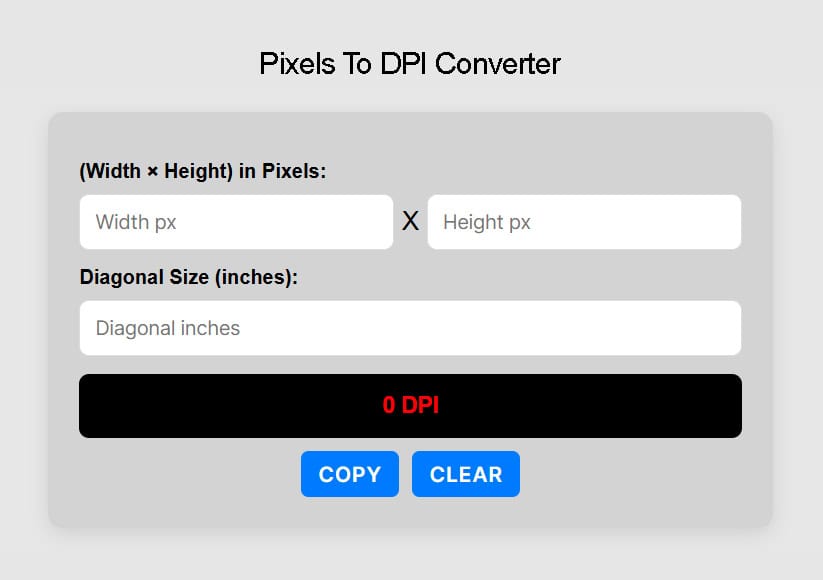
- Enter the Pixels: Pop in the width and height of your image (or screen) in pixels.
- Add Your Diagonal Size: Enter the physical diagonal size of your intended print or screen in inches.
- Let our tool work its magic. It will instantly spit out the exact DPI you need!
Want to Do the Math Yourself? (The Formula)
If you’re a curious creative who likes knowing the “how” behind the tool, converting pixels to DPI manually actually requires two steps.
First, you have to find your diagonal in pixels using the Pythagorean theorem (flashbacks to high school geometry, anyone?):
- Diagonal In Pixels = √(width² + height²)
Once you have that number, you divide it by your physical diagonal measurement in inches:
- DPI = Diagonal In Pixels / Diagonal In Inches
Or… you could just scroll up and use our free calculator to get your answer in half a second!
Need to Go in Reverse?
Sometimes you already know the DPI your printer requires (usually 300 DPI for high-quality prints), but you need to figure out how many pixels your digital canvas needs to be before you start designing.
No problem at all! You can easily flip the script and head over to our DPI to Pixels Converter to calculate exactly how large your digital file needs to be.
Pixels To DPI Conversion Chart
This is a table for px to dpi conversion results at 23 inches diagonal size.
| Pixels | DPI |
|---|---|
| 600 X 600 Pixels | 36.89 DPI |
| 300 X 300 Pixels | 18.45 DPI |
| 213 X 213 Pixels | 13.1 DPI |
| 240 X 240 Pixels | 14.76 DPI |
| 1200 X 2400 Pixels | 116.66 DPI |
| 4800 X 1200 Pixels | 215.12 DPI |
| 600 X 1200 Pixels | 58.33 DPI |
| 1280 X 720 Pixels | 63.85 DPI |
| 3000 X 2000 Pixels | 156.76 DPI |
| 4000 X 3000 Pixels | 217.39 DPI |
| 4000 X 4000 Pixels | 245.95 DPI |
| 3000 X 2400 Pixels | 167.04 DPI |
| 1200 X 2400 Pixels | 116.66 DPI |
| 2100 X 1500 Pixels | 112.2 DPI |
| 1024 X 768 Pixels | 55.65 DPI |
Frequently Asked Questions (FAQs)
What is a good DPI for printing?
For high-quality, professional prints (like photos or brochures), 300 DPI is the magic number. If you’re just printing a text document for yourself, 150 DPI will usually do the trick. For web and digital screens, 72 to 96 DPI is standard.
Does changing DPI change my pixel size?
Nope! Changing the DPI only changes how densely those pixels are squeezed together on paper. The actual number of pixels—the digital size of your file—stays exactly the same unless you actively resize or resample the image in a photo editor.
Can I just increase the DPI to make a low-res image look better?
Unfortunately, no. It’s like trying to stretch a small amount of dough into a giant pizza; it just gets dangerously thin. If you only have a 500×500 pixel image, changing the DPI to 300 won’t add new details. It will just shrink the physical size of the print to squeeze those few pixels tightly together. To print large and clear, you need more actual pixels from the start.